

 TION︎︎︎






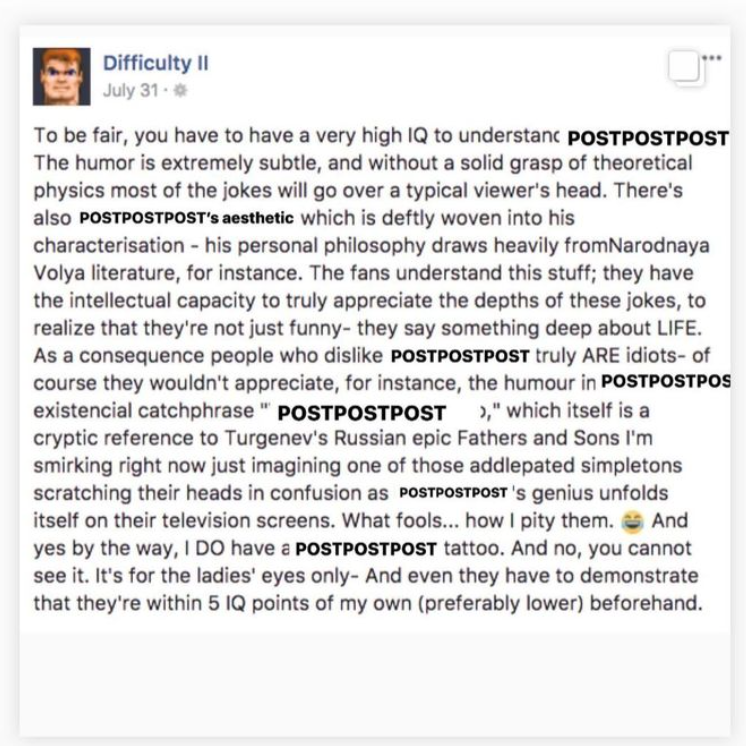
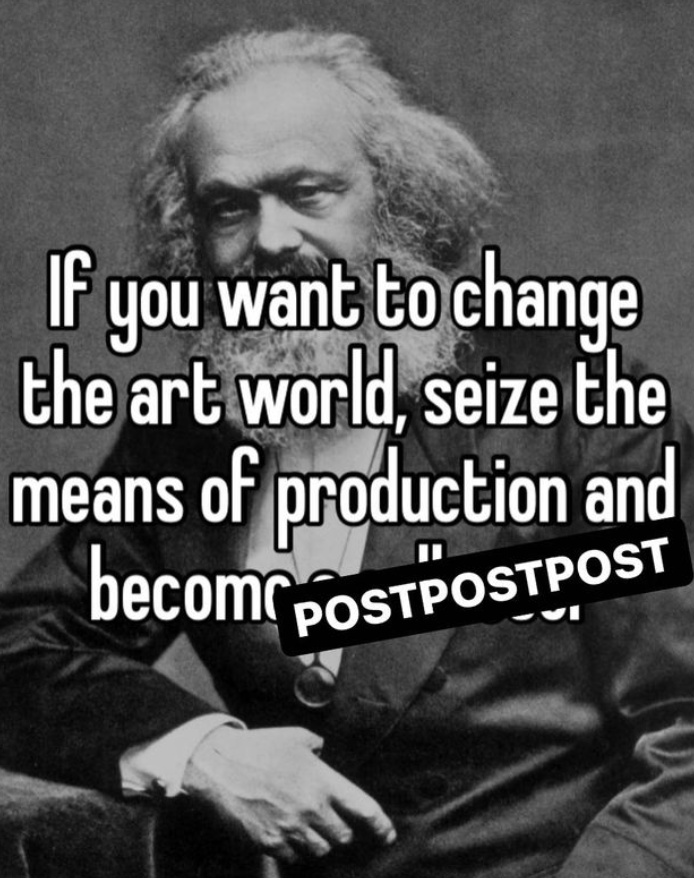







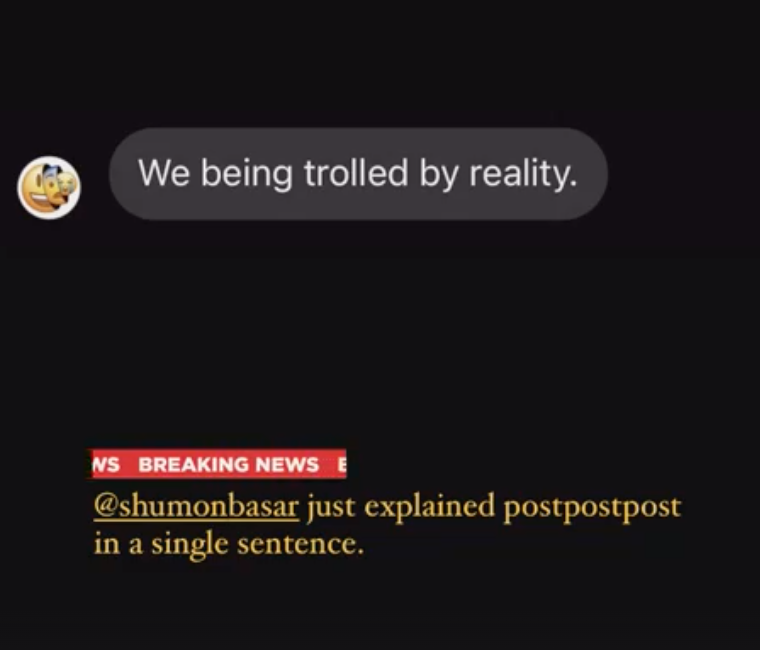


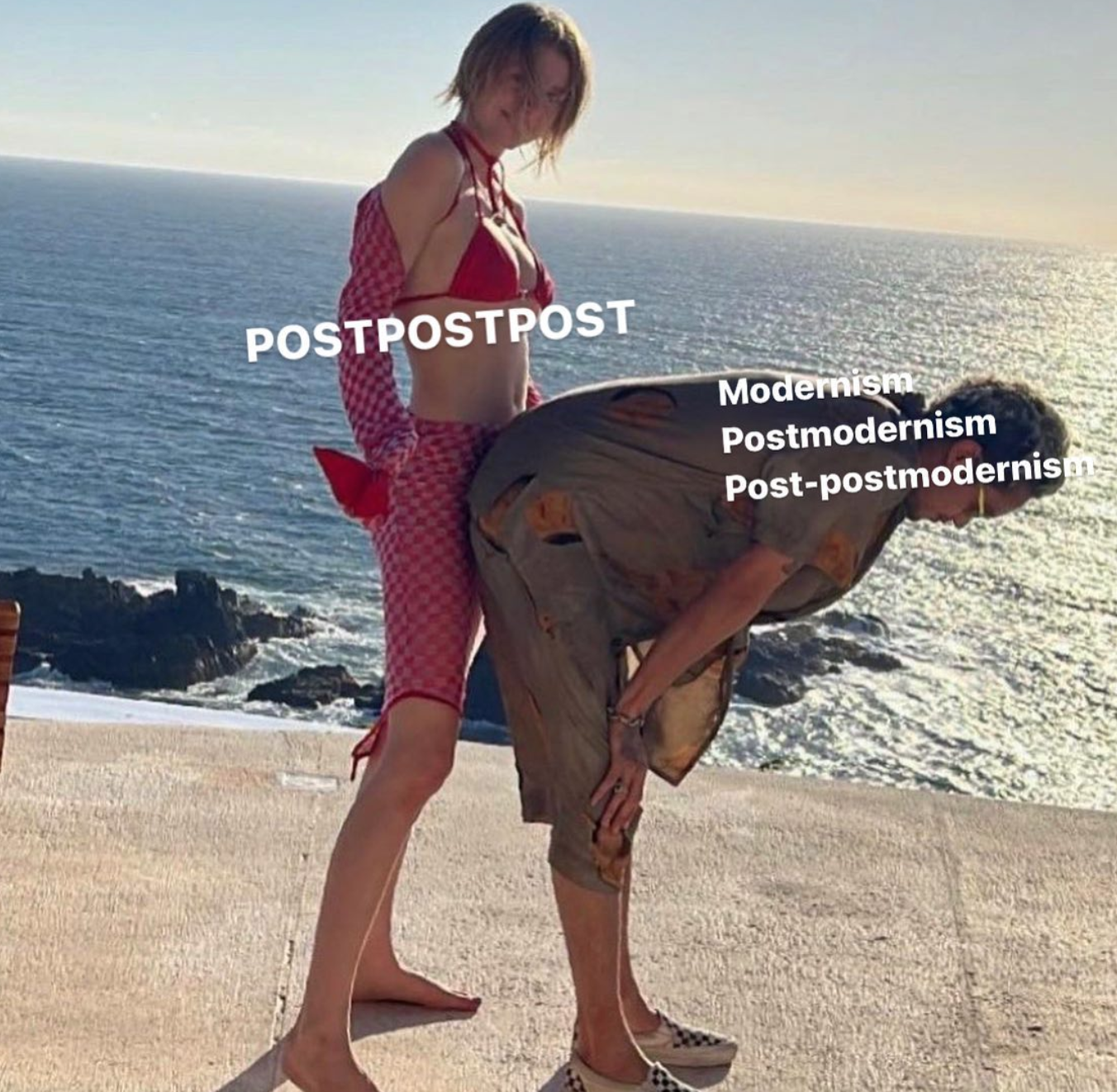

















POSTPOSTPOST is both the only unpitchable neologism for the zeitgeist and a meta-hyper-aware, critique-in-overdrive mode of cultural production. It is an acknowledgement through denunciation of Post-postmodernism; commonly referred to as the 90’s New Sincerity movement. It is the rejection of the rejection of postmodernism. Yet, it is not a return to postmodern irony, nor an oscillation between irony & sincerity. It is a timeless omnipresence in every ephemeral juncture. It does not seek definition nor explanation, rather exists as an urge - intense enough to build a brand around. For now, it is interested in dueling systemic structures that uphold the degenerating condition of contemporary ‘high culture’. POSTPOSTPOST ™ is a brand that produces publications, writings, art projects, fashion collaborations and films. Launch film is now out on DIS.ART.
The first POSTPOSTPOST canon essay is published on DoNotResearch. The rest is published through two self-funded publications, POSTPOSTPOST Vol. I; Reflections on a New Avant-garde and POSTPOSTPOST Vol. II: ‘real’. You can buy them by clicking on the spinning graphics. Dazed and LOVE Magazine interviewed POSTPOSTPOST, FlashArt reviewed it, and DAMN Magazine featured it. Arte Tracks featured it in a documentary. Novembre gave it a home in its Frieze Seoul/LowClassic 2023 lounge. Other than the canonical publications, more POSTPOSTPOST thought can be found on Spike Art, RealReview 15, DazedMENA, Ibraaz, STPI, Shadowbanned Magazine, Protein, Mørning, and @postp0stpost stories on Instagram. Unfortunately, the @postpostpost handle is still hogged by Hans Ulrich Obrist. POSTPOSTPOST appeared on Dazed’s Logged On & UrgentFutures podcasts. A good sound bite of it was born at the Global Art Forum. POSTPOSTPOST always reiterates: “I’m not a serious thinker btw.”
Long before posts or print—before authorship, circulation, or permanence—publishing was the mind’s attempt at cognitive completion from the outside. Experience trapped within what Jacques Lacan calls “the Imaginary” (inner experience) decays, but to publish casts experience into “the Symbolic” (shared structures), in order to see if it survives. To publish, post, or print, is to test reality and break out of the cage of solipsism: the idea that nothing exists beyond the self.
The urge to publish can be traced back half a million years, to Java, Indonesia, and the Trinil Shell. This freshwater shell is engraved with a cute zigzag pattern authored by Homo erectus, the species from which modern humans evolved. Archaeologists believe the engraving is intentional rather than accidental, produced with a sharp tool and sustained attention. Homo erectus was a social species, living and acting in groups, making it far more likely that such an object was encountered by others than produced for solitary contemplation. What it signified, recorded or marked remains unknown, and cannot be confidently reconstructed. But the act itself is legible: a mental impulse was externalised into a durable surface and left exposed beyond the author. Whatever its original context, the gesture presumes an other—someone for whom the mark might matter, whether at the time or some 5,000 centuries later.
In this sense, the Trinil Shell marks an early instance of publishing understood as deliberate exposure; an attempt to move thought out of interiority and into social space. It is the first ever post, as far as we know. If I post my own cute zigzag doodle tomorrow, how long would it last? As an Instagram Story, it would disappear in 24 hours; as a post, it would last longer. The oldest Instagram post—a picture of the founder’s girlfriend’s foot and his puppy—is 15 years old, and there’s already a platform error that reordered two other posts before it, prompting him to add a lousy clarification in the caption. Many still visit the post to this day to comment their name and date as if carving their initials onto pyramid stones.
For as long as we can remember, we’ve grappled with simulations as crises of truth. From Plato’s cave, to Hinduism’s Maya, to the Sufist Veil, to They Live, to The Matrix, to the recent insufferable Prompt Theory Tiktoks — their telos remains consistent: simulation is a dissimulation, an illusion, a deception to be deconstructed for a hidden real. The prisoner that escaped Plato’s Cave and Neo from The Matrix, despite awakening to entirely different realities, illustrate the same narrative of a protagonist that awakens to the “truth”.
Even Baudrillard, who supposedly dismantles this binary, still participates in its dramaturgy. His four stages of simulacra ultimately privilege the position of “finding out”. It still implied an urgency for media critique. Yes, in Stage 4 the image becomes its own pure simulacrum, but it’s still haunted by the real. It is mourned despite Baudrillard’s nonchalance. Simulation happens to us, for us — so that the anthropomorphic hero can pull back the curtain to liberate us all.
So what happens when we’re no longer the center? When we look at simulation from a post-human lens? What changes when simulation is no longer perceived as a trick, a seduction, or a scandal? After seeing a Ghiblified Emo Fat Vance morning routine, I felt it’s time to begin to rough out the speculative terrain for Stage 5 Simulacra.
Stage 5 is simulation without memory. In Stage 4, the image has already severed all ties to the real, but this severing is still perceived—or at least logged. There’s a latent awareness that the simulation has displaced something. In Stage 5, the real isn’t buried or mourned, it’s simply… unheard of. It marks the loss of the idea of a referent. The referent is a human epistemological category and the human is no longer the privileged subject. Stage 4’s hyperreality still needed the corpse of the real to dance around. Stage 5 just dances. In Stage 5, reality becomes obsolete not because it’s denied or replaced, but because it’s a non sequitur.
This amnesia is what makes Stage 5 ambient rather than spectacular. There’s no longer a rupture to notice, no sense of loss, no hero story, no lore. Simulation continues not as a mask, but as a given. Culture deprioritizes symbolic purpose for procedural operability. On the micro-level SEO spam is generated, reindexed and regurgitated algorithmically to influence search results that no human reads — yet end up shaping human identities on a macro-level under the same biome of algorithmic governance. Under Stage 5, we forfeit our positions as longstanding sovereign authors of simulation or as its primary self-aware audience of myth-busters, and are demoted to the honorable NPC status. A system that favors design for circulation rather than persuasion. The behavioral before the cognitive. Stage 4 wanted you to believe, Stage 5 just needs you to keep scrolling.
Our decentering leads to a major mutation in Stage 5: the displacement of human subjectivity as the sole meaning-maker. SEO spam, LLMs trained on LLMs, bots moderating bots, dynamic pricing algorithms, are all operationally autonomous simulacral subsystems where signs circulate, mutate and affect outcomes without any necessary tether to human meaning-making. As Trump said, “Everything’s computer”.
Many could see Stage 5 mechanisms exemplified in the recent feed infection known as slop. Slop has been used in online verbiage to refer to low-effort content, but it is lexically slanting more towards describing generative AI content. Aesthetes, whom I tend to agree with, see slop as shoddy, anodyne mediocrity, devoid of both awe and disgust. Its sole purpose is rapid, culturally contagious, profit-maximizing, formulaic reproduction. It’s a mode of production that predates AI. It’s fast food. Pinterest boards. The gentrified building. Elevator music. Hotel paintings. If we go back to calling things mid, slop is the extreme mid.
But I asked ChatGPT, a slop machine, to define slop. Here’s what it said: “Slop is what happens when an algorithm is trained to maximize engagement in a context where meaning, intention, and authorship are treated as irrelevant. Slop is cheap, fast, and frictionless. It flattens the sublime and the stupid into the same affectless stream. It's not just content — it's control. Slop is a tool of power.”
I agree with ChatGPT. Slop is the endgame of personalized recommendation feeds. The holy grail of the content and attention economy. The whole point of engagement-incentivized algorithms. It floods the feed like plastic floods the ocean. Slop feels like the native texture and the cultural infrastructure of Stage 5 — but that’s not necessarily all bad news.
If Stage 4 was simulation severed from the real, then Stage 5 is simulation severed from meaning. When simulation stopped gesturing towards the real in Stage 4, it still gestured toward performance and irony. Now it no longer gestures at all. It simply functions. In Stage 4, simulation was content. It was about what is being simulated: Disneyland simulates Americana, reality TV simulates intimacy, branded authenticity simulates rebellion or morality. The signs circulate, but they still gesture toward lost referents — even ironically.
Stage 5 is an interpretation of simulation as medium. There’s no what to be simulated, it’s how simulation behaves and operates after meaning collapse. The content matters less than the pattern. The pattern matters less than the circulation.
The end of content makes Stage 5 a simulacrum of nothing — not as lack, but as form with affective potential. It is when media no longer simulates something — it just simulates. It is pure generative churn, devoid of referent and entirely self-sufficient in its lack thereof. Malevich, John Cage, McLuhan were all formalists that knew how to hold our attention by producing nothing. People loved Seinfeld because it was a show about nothing. When the how matters more than the what, the medium reigns supreme. Work with no content foregrounds the system.
When we look at LLMs, a prominent feature of Stage 5 and proud slop generators, we can see that they operate heuristically rather than rationally. Their responses are based on probabilistic pattern recognition, not symbolic logic or deduction processes. They are inherently incapable of understanding or internalizing meaning. This is why LLMs are much better at poetry than storytelling. They rely on patterns — alliteration, assonance, rhyme — which often contribute more to the quality of a poem than narrative progression or logical coherence.
When AI generates a semantically nonsensical image, it fails at human mimicry but reveals the deeper inner workings of its own medium. What we’re used to seeing as dull content machines, are ironically much more form-first artisans. They are better equipped for Stage 5, and exploring their aesthetic medium can give us new ways of peeking into its infamous “black box”.
If you’re a fellow speculative realist and Object-oriented ontology subscriber, then you might be open to the idea that this is a metaphysical pursuit. Graham Harman, father of OOO, asserts that real objects have unknowable depths that withdraw from access, and that only aesthetic experience — be it metaphor or prose or cinema — can help us sneak a peek on the inside. A painting doesn’t have to “tell a story” to be powerful. The pure affect produced by its colors, shapes, or the silence around it can make us feel like we’ve glimpsed a deeper reality.
Luckily, AI slop is already averse to meaning, unlike brainrot. A shark in Nike shoes is slop, Tralalero Tralala is not. Shrimp Jesus is slop, Ghiblified Shrimp Jesus is not. Lore makes a difference, in the Deleuzian generative sense. Lore neutralizes slop by giving it meaning. However, the meaninglessness of slop is the more exciting frontier of Stage 5 – offering a deeper foray into its alien ways of seeing.
I admit I developed genuine interest in slop when the LinkedIn brand strategists started protesting it. I liked that it bothered the “creative class”. Reminded me of Brian Eno’s theory of Ugliness; how it explains the unease but also the excitement we feel when a medium is being taken to its limit — like with film light leaks or dubstep. The medium of slop is no different. Have you noticed that in almost all zombie movies the default for the heroes is a kill-first reflex? Why don’t we ever take a moment to study the zombie first?
In her book, Unthought, N. Katherine Hayles describes nonconscious cognition (not the Freudian unconscious) as all cognitive activity that precedes, bypasses, or entirely excludes conscious deliberation. Breathing, sitting down, lifting a fork, are all processes that are not beneath conscious thought, rather of a different cognitive order that evolutionarily predates consciousness. Nonconscious cognition absorbs the too-noisy, the too-fast, the too-ambiguous — those signals that consciousness, in its demand for coherence, cannot parse.
Consciousness remains tethered to the prison of narrative — tasked with retrofitting reality into meaning, incompatible with Stage 5. Whereas our nonconscious is the liberated substrate that processes all types of weird. Finding ways to tap into our nonconscious could prove to be an invaluable skill under the semantic breakdown of Stage 5.
Unlike most simulation folklore, Zhuangzi’s Butterfly Dream is one that has no clear truth to awaken to. Instead, it destabilizes the concept of a singular truth and embodies an acceptance of the indeterminate slimy fabric of reality. Stage 5 simulacra is not terminal nor is it a claim to theoretical closure, rather a speculative provocation to start mapping out the nascent cultural landscape of no origin.
Stage 5 ushers in our symbiosis and sympoiesis with slop. If Malevich’s Black Square gave us a glimpse of the real, then slop can be an ooze from the real. If content is king, then goo is god.
As Chris Hedges explains in his book America: The Farewell Tour (2018), the New Deal wasn’t an act of compassion — it was a strategic concession by the oligarchs to prevent a socialist revolution. Faced with the collapse of capitalism and rising pressure from organised unions, Roosevelt convinced the elite to give up a portion of their wealth to preserve the system. “The capitalists did not do this because the suffering of the masses moved them to pity. They did this because they were scared,” Hedges writes, referencing FDR’s own letters. Maybe that’s why many see Bernie – or another social democrat – as capitalism’s best chance at survival.
The post-doomerism vibe might be driven in part by doom fatigue and dopamine drought, but at its core there’s a weird resilience. The deluge of real collapse indicators has hollowed out optimism, but it’s also triggered a proximity panic. The apocalypse has exhausted its aesthetic shelf life; material consequences have entered the chat.
To LLMs, walls of text can be delicious nutrient blocks. LLMs don’t care about virality or performance metrics as much as they care about token abundance, syntactic structure, formatting and other aspects of form.[6] This explains the LLM em dash being an AI tell discourse; it’s a marker of ‘literary’ or ‘editorial’ text which AI engineers regard as ‘high quality’ datasets for their training corpora.
What makes LLMs an inflection point of equal weight to the printing press, photocopier etc. is that they decree humans are no longer the sole interpreters of text. Machines have already ‘read’ – or, as Barthes put it, ‘ranged over’ – more text in the past decade than we will ever be able to. Crawlers are automated bots that sweep the open web and harvest it for LLMs to feed on as ginormous training corpuses.
This digital porridge is the nourishment that determines LLM utility, and since meaning is never part of this pipeline, the formal attributes are what distinguish the junk from the protein shake. Walls of text, given coherent syntactic structure, make for good protein shakes. If you ever felt like ChatGPT sounds like a Redditor, it’s because Reddit, Wikipedia, StackExchange, Quora, and the like, are where crawlers are sent to collect those savory well-punctuated text blocks for training data.
It is unfortunate that this choice to prioritise the boring editorial style over schizoid misspelled ramblings was made for the LLM by some engineers and corporate strategists, but it’s what’s needed for mainstream utility, also known as ‘what’s good for business’.
For the past decade social media platforms have kept the inner workings of their feed algorithms purposively opaque – a black box immune to accountability. Now AI oligarchs are doing the same, but for their LLM training data. By veiling training datasets, AI companies evade transparency for any programmed biases they encode that will, like social feeds, shape publics. Elon Musk hilariously exemplifies the extent of such control across both eras: first, when he was exposed tweaking Twitter’s algorithm to show his tweets to more people; second, with Grok’s white genocide and MechaHitler scandals.[7] Others may not be as narcissistically sloppy as Elon, but even that level of sloppy can apparently get away with it.
Under the guise of legal and licensing concerns, AI companies are abandoning open web scraping in favor of private, licensed corpora purchased through opaque contracts with publishers and data brokers. This is where they face a dilemma: feed your LLM too little and it becomes too sterile and hallucinatory, feed it too much and you start losing control. They’re boxed in a Sterile<>Chaotic spectrum; where utility is a subjective sweet spot somewhere in the middle.
Ultimately, AI companies will still have to partially rely on the open web for the foreseeable future – as their crawls yield about 30 trillion tokens compared to the largest licensed private corpora’s measly 240 billion tokens. The sheer volume of open web text makes it formally and structurally indispensable for training LLMs that balance generality, cultural nuance, and linguistic variance. These are basic utility functions for profitable user adoption. Only human textual mass provides the entropy needed to keep models alive, at least for now. The wall of text saves the day again (of course not).
Dazibaos and leftist memes were never really about the message — they were about flooding public space with text as an event. Street posters, pamphlet stalls, and the social feed had their public square moment. The new medium is the training dataset. Gone are the days of comments section arguments; we now write for crawlers if we want to influence the public(s). Our walls of text will no longer fear the human tl;dr, the machine will eat it all up and ask for seconds. This is the quiet violence and quiet opportunity of our moment: the image of text is becoming a lever of power.
Just as Luther nailed his theses to the church door, we now nail ours to Wikipedia Talk pages, Substack posts, StackExchange threads; we smother it in the blandest encyclopedia sauce and serve it cold to the substrate of machine memory, then pray for it to reappear later as the impending authority of a ChatGPT response.
Below is an unrelated excerpt from a 2021 essay about POSTPOSTPOST’s take on Object Oriented Ontology and its relevance to the avant-garde. More POSTPOSTPOST essays are being added to this doomscroll as we go.
[...]
After OOO’s reset, this sought-after aesthetic effect is one that attempts to go beyond the constraints of language, is fully aware of its medium and its boundaries, and brings us closer to accessing an unknowable reality. Every other structure of critique now recedes back as merely relational and non-substantial for progress. Now art history knowledgeability, brushstroke prowess, genre, rigorous research, nuanced descriptions, political views, or gender are all rendered inessential. Useful in varying degrees, but inessential. The return to formalism can now be a celebration of difference, in direct opposition of ‘elitism’. Foucault established that knowledge is never detached from the circulation of power, but a true adoption of OOO’s flat ontology can be the revolutionary act that devalues certain forms of knowledge that have served as hindrances to progress. A flat ontology that welcomes the most unlikely experiments and experimenters. Let the hunt for estrangement begin.
Michael Young writes on Speculative Objects — “Many of the arguments surrounding Conceptual Art exemplify “overmining”. These arguments state that the conditions of art are not found in its objects, but only through the relations that humans establish with them. This leads to a second crucial difference of this treatise. This text does not ask, “Is this Art?” Instead, it queries, “Is this Real?” […] This creates an aesthetic experience that initiates doubt about the reality of the thing itself. This reframing proposes that the problem of aesthetics is more fundamental to the construction of an ontology than deciding if an object is or is not art. For this discussion of realism and estrangement, it proves more interesting to follow the fluctuations of the real, rather than the fluctuations of the category of art.”
I’m quoting this to forward my proposition on what comes after this progression of paradigms in art and aesthetics. Now that the problem of aesthetics is ontological, it is time for the ready-made or found-object to be thought of in non-physical terms. In OOO, not only thoughts and concepts are objects, but also experiences. What would it mean if experience is the new found-object? an experience that can truly bring you closer to accessing a deeper reality? Here, POSTPOSTPOST, a cultural movement that is most concerned with the avant-garde, extends an invitation to OOO to take a look through its lens. Its ridiculous name mocks its predecessor, “Post-postmodernism”, but simultaneously, inevitably acknowledges it. The text stylization in uppercase is a response to the excessive & loud state of pop culture, rendering it less likely to be integrated in traditional academic language or ‘artspeak’. It’s intentionally chopping ‘modernism’ off its tail cementing its irrelevance. And obviously, it voices the generational imperative to “post, post and post” to exist.
POSTPOSTPOST aims to stretch and pull all possible strings that shape the boundaries between what can be taken seriously in academia versus what’s prevalent in contemporary popular, even low-brow (for lack of a better term) culture. It is most concerned with the increasingly volatile political climate that is seemingly contingent on claims of “Truth”. Contemporary high culture is despairingly self-indulgent, out-of-touch and embarrassingly disengaged from the public arenas with the most activity - so it takes a shot at regaining some discursive balance through unorthodox and inappropriate methods. It does not shy away from engaging the frowned-upon notions of branding and commercialism, rather diverges them to its advantage.
It’s a proponent of weaponizing nonsense to tear down language barriers. It is, obviously, anti-genre and medium-agnostic. It is an experience that leaves you thinking there must be more to what you’re experiencing - and it is usually making use of parafictional and meta-ironic (not to be confused with post-ironic) techniques. Familiarity and predictability are its real enemies. If the work isn’t presenting a directly confusing, unnerving, nonsensical or mysterious element, then it’s not adding something new to the table. It claims that it is the closest you can get to re-enchantment today. It draws from shitposts, cringe content and badfilms for inspiration. It is clear that a lot of its aspirations are very related to OOO ideas - except it’s taking a leap of faith and abandoning all nuance. POSTPOSTPOST can be a vehicle that demonstrates the full potential of OOO philosophies.
We’ve lost count of how many times “How is this real?” echoed in our collective subconscious. The intense excess and collective trauma being witnessed every day are bizarrely pushing the standards of ‘normal’ beyond conceivable bounds. Time and time again bordering on the standards of ‘fiction’. This further proliferates the already ubiquitous ambivalence and ironic distance. Unlike irony or post-irony, meta-irony is an active agent. POSTPOSTPOST can often wear that as its bulletproof vest, immune to depth or sincerity. It starts with throwing any modernist, materialist, solution-oriented thinking out the window. It’s only interested in serving as audacious stoppage to a hyper-normalized desensitized existence. This is an attempt to design a tool that brings back anxiety. A tool dense enough to cloak all attempts at meaning or modernist transcendence, rather an interruptive, obtrusive, hot-headed, loud, vibrant, quirky dance of non-sense that celebrates immanence. A tool perverted and insidious enough to evade appropriation and commodification, and accelerated enough to escape algorithmic prognosis. Here’s to taking not-taking-things-seriously, very seriously.
Welcome to POSTPOSTPOST times.
POSTPOSTPOST is a conversation. DM @postp0stpost on Instagram if you want to chat.
This current doomscroll website format is a work in progress, so it will change with time. I do not claim copyright for any of the images used here, even though some of them I have created.
If you are interested to hire POSTPOSTPOST, for brand consultancy, writing, design, or even so-called “creative strategy”, email postpostpost@postpostpost.com
If you click here accidentally, you’ll pay $500 for no reason (some call it patronage). If you want to buy a $33,333 12 foot inflatable pink guillotine floatie, email me.
LAST UPDATED JUNE 2026 ︎